Local hospitals close and downsize across state in 'just a terrible situation'
Regional News

Audio By Carbonatix
6:21 PM on Friday, November 20
Ford Turner
(The Center Square) - Retired elementary school teacher Jennifer Groff had two babies in Pottstown's community hospital. Debra Baldwin was born there and so was a grandson. Ruth Ann Green had four babies there.
The arrivals helped bind the hospital to the soul of the community. That much is clear in conversations with mothers who gave birth at Pottstown Hospital or one of its predecessors in the borough of about 23,000, situated close to the juncture of three busy and populous counties about an hour outside of Philadelphia.
That piece of the community's soul was torn out six years ago when the maternity ward closed.
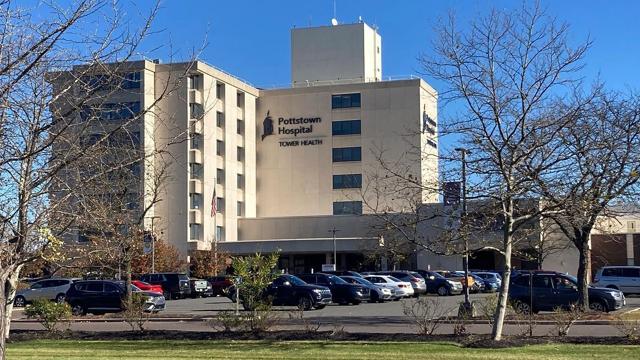
Now, other pieces are being torn away. Pottstown Hospital has made multiple cutbacks and community members say many medical services long offered there - involving among other things cancer, pediatric, and at least some types of scans - must be obtained at hospitals or sites much farther away.
Similar stories are playing out in hospitals across Pennsylvania. The places which essentially are supposed to help prevent death, are themselves dying.

Jennifer and Dan Groff of Pottstown, Pennsylvania
Jennifer and Dan Groff, who live in Pottstown, Pennsylvania, are dismayed by the cutback in services at Pottstown Hospital. "It is ridiculous that they don't have a maternity ward here," Dan Groff said. Photo: Ford Turner / The Center Square
"I think it is ridiculous that they don't have a maternity ward here," said Dan Groff, Jennifer Groff's husband. "For a community this size to not have a maternity ward is insulting."
State politicians are well aware of the widespread problem. So far, they have not been able to corral it.
"We can't be losing hospitals the way we are losing hospitals in the Commonwealth," said Democratic state Sen. Tim Kearney of Delaware County. "It is just a terrible situation."
Four hospitals were closed by a single company in recent years in Kearney's region.
Thirty-two Pennsylvania hospitals closed completely over a 20-year period and another 25 shut down crucial offerings like maternity or emergency care, according to a January, 2025 report from the Pennsylvania Health Access Network. A more recent report from the think tank Center for Healthcare Quality & Payment Reform found 18 rural Pennsylvania hospitals are at risk of closing.
There are multiple causes. Private equity has bought hospitals and gutted them financially, the federal government has reduced Medicaid reimbursements, and both for-profit and nonprofit systems have overexpanded and then had to downsize or close facilities. The stress of the COVID-19 pandemic made things worse.
The most recent casualty is Sharon Regional Medical Center.
The facility near the Ohio border first closed in early 2025 when its owner declared bankruptcy. It then reopened with a new owner.
Earlier this month, however, the state Department of Health ordered Sharon to close again and revoked its license.
The state order, posted online by Becker's Hospital Review, said the hospital showed disregard for patient and staff safety by failing to guarantee basic utility service. Attached to the order was a copy of an electricity termination notice for the hospital, tied to an unpaid bill of more than $630,000.
'We are better than that'
"A financial calamity" is how the Sharon closure was described by Republican Sen. Michele Brooks. The hospital is in her district.
Rural hospitals in Pennsylvania, Brooks said, occupy obsolete buildings and need capital improvements and new equipment. Medical residents she has spoken to say "they want to train on the newest and best equipment."
The state, she said, could work on the hospital situation with some of the $193 million it was awarded under the federal Rural Health Transformation Fund program.
The state has to be re-think its process concerning hospital problems and be flexible, according to Brooks. Closed hospitals, six-hour waits in emergency rooms, and people stretched out on gurneys in hallways are not an acceptable situation, she said.
"We are better than that," she said.
Attempts to contact Republican Rep. Parke Wentling, whose district includes Sharon, were not successful.
January will bring a new legislative session to Harrisburg, along with all-Democratic control of the General Assembly instead of the divided control of the last several years. Optimism was expressed by Kearney, author of one of the key hospital-related bills that did not pass in the 2025-26 session.
A key concept was giving the state attorney general power to determine whether a hospital purchase is in the public interest. A similar bill introduced by fellow Delaware County Democratic lawmaker Rep. Lisa Borowski passed the House with bipartisan support but couldn't clear the Republican-controlled Senate.
Come next year, Kearney said, "We are going to get another bite at the apple."
'I don't like what's going on'
Retired machine shop worker David L. Green has to get PET scans - the acronym stands for Positron Emission Tomography - because of concerns about his lymph nodes.
He lives in Lower Pottsgrove Township, just across the municipal line from Pottstown borough and the hospital where the scans are done. But because of the cutbacks, he has to drive to Phoenixville, about ten miles away.
He's 86.

David L. Green of Pottstown area, Pennsylvania
Because medical services have been cut back at Pottstown Hospital, 86-year-old local resident David L. Green now has to drive much farther to get his medical scans evaluated. Photo: Ford Turner / The Center Square
His son, Bob, has had hip surgery, back surgery, and hernia work done at the local hospital over the years.
"I don't like what's going on," said Bob Green, also a machine shop worker. "I hear that it is going to close. I have a nephew who tells me it is going to close."
Democratic Rep. Joe Ciresi, whose district includes the hospital, said owner Tower Health has said it will not close Pottstown Hospital. "Of course I am concerned," Ciresi said.
An email sent to a longtime media specialist at Tower Health elicited a phone call, followed by a written response, from an outside strategic communications company.
"Pottstown Hospital has cared for this community for generations, and it is an important part of Tower Health's future. We are making a multimillion-dollar investment to expand the Emergency Department, add inpatient behavioral health beds, strengthen outpatient behavioral health services and renovate parts of the hospital," the Tower Health statement delivered by the outside company said. It also said, "Pottstown Hospital remains a full-service community hospital. We are fully committed to Pottstown and the surrounding communities, and these investments are designed to keep the hospital strong and sustainable for generations to come."
Tower Health's website describes it as a "strong, regional, integrated healthcare provider and payer system" with four hospitals, a combined 1,200 beds, and over 10,000 "team members."
Federal tax-exempt organization filings available online show that in the year ended June 30, 2025, Tower had 2,765 employees. The line for "total number of volunteers (estimate if necessary)" showed 133.
Executive compensation data showed six individuals each had packages that added up to more than $1 million. Those included President and CEO Michael Stern with more than $1.5 million and Executive Vice President Dan Ahern with more than $1.3 million.
In Pottstown, Christie Aurich was pregnant when the local hospital shut down the maternity ward. She ended up having her little boy in October, 2020, in Bryn Mawr.
Now 44, Aurich said she would have vastly preferred to have the baby near home. "It would have been wonderful for keeping the family together," she said.
Dan Groff, who is a network planner and project manager, has to get upper gastrointestinal tract scans every two years because of a chronic, genetic condition. He can no longer get them at the local hospital.
His own guess is that there are 100,000 people in the immediate area.
Groff said, "Tower Health claims they are nonprofit, but yet they can't keep a regional hospital open."